Showing posts with label flu. Show all posts

Tuesday, September 22, 2009

How beautiful the enemy


This incredible piece of art is actually a 3-dimensional model of the H1N1 "swine" flu virus. It was designed by artist Luke Jerram as part of a series of microbial pathogens. Jerram has this to say about this collection:
Its great to be exploring the edges of scientific understanding and visualisation of a virus. Scientists aren't able to answer many of the questions I ask them, such as how the RNA is exactly fitted within the Capsid? At the moment, camera technology can't answer these questions either. I'm also pushing the boundaries of glassblowing. Some of my designs simply can't be created in glass. Some are simply too fragile and gravity would cause them to collapse under their own weight. So there's a very careful balancing act that needs to take place, between exploring current scientific knowledge and the limitations of glassblowing techniques.
A video of HIV being "made":
(Via Freakonomics)

Sunday, May 17, 2009

Flu update

Here are the flu numbers at the end of last week:


4,714 confirmed cases in 47 states with 4 confirmed deaths (2 in Texas, one in Washington, and the latest in Arizona). There have been 30 confirmed cases in Kansas (34 according to the Kansas Department of Health and Environment). These have occured in Dickinson, Ford, Geary, Johnson, Ottawa, Riley, Saline, Sedgwick, and Wyandotte counties.

Wednesday, May 13, 2009

Flu update

Here's a little different look at the data. This graph shows total confirmed flu cases in the US for each day since April 23:
Can any of my biology students explain the significance of the shape of this curve?

Tuesday, May 12, 2009

Flu update

Here's the latest numbers from the CDC:
3009 confirmed cases in 45 states with 3 deaths. This rate of mortality here is consistent with typical seasonal flu strains. What's not typical is how quickly this thing is spreading. The last time I did an update was last Thursday, and the numbers then were 893 cases in 41 states, with 7 confirmed cases in Kansas.

The question I have is this: Is it, perhaps, a GOOD thing that this virus is spreading quickly? Since it doesn't appear, at this point, to be exceedingly lethal, maybe it's a good thing that it's spreading rapidly. If the virus goes away over the summer and returns in the fall as some health experts are predicting, then wouldn't it be beneficial that a large percentage of the population was exposed to it now and will therefor have a degree of immunity to it? Especially if it mutates and becomes more deadly between now and then? I don't know...it's just a thought.

For now, it's still something to be taken seriously. And by that I mean keep washing your hands and covering your mouths to cough and sneeze. If you feel sick, stay home and call your doctor. Get lots of rest and drink lots of fluids. And don't panic...we've got a long ways to go before we reach "HFC" level.

Thursday, May 7, 2009

Flu virus evolution

Earlier this week, The New York Times website posted an interesting article by Carl Zimmer in which he discusses how viruses are able to continually evolve into new varieties, and how that relates to the current "swine flu" pandemic. Here are some of the highlights:
The current outbreak shows how complex and mysterious the evolution of viruses is. That complexity and mystery are all the more remarkable because a virus is life reduced to its essentials. A human influenza virus, for example, is a protein shell measuring about five-millionths of an inch across, with 10 genes inside. (We have about 20,000.)

Some viruses use DNA, like we do, to encode their genes. Others, like the influenza virus, use single-strand RNA. But viruses all have one thing in common, said Roland Wolkowicz, a molecular virologist at San Diego State University: they all reproduce by disintegrating and then reforming. [...]

Viruses are diverse because they can mutate very fast and can mix genes. They sometimes pick up genes from their hosts, and they can swap genes with other viruses. Some viruses, including flu viruses, carry out a kind of mixing known as reassortment. If two different flu viruses infect the same cell, the new copies of their genes get jumbled up as new viruses are assembled. [...]

As new hosts have evolved, some viruses have adapted to them. Birds, for example, became the main host for influenza viruses. Many birds infected with flu viruses do not get sick. The viruses replicate in the gut and are shed with the birds’ droppings.

A quarter of birds typically carry two or more strains of flu at the same time, allowing the viruses to mix their genes into a genetic blur. “Birds are constantly mixing up the constellation of these viruses,” said David Spiro of the J. Craig Venter Institute.

From birds, flu viruses have moved to animals [sic], including pigs, horses and humans. Other viruses, like H.I.V. and SARS, have also managed to jump into our species, but many others have failed. [...]

Only a few strains of influenza have managed to become true human viruses in the past century. To make the transition, the viruses have to adapt to their new host. Their gene-building enzymes have evolved to run at top speed at human body temperature, for example, which is a few degrees cooler than a bird’s.

Influenza viruses also moved from bird guts to human airways. That shift also required flu viruses to spread in a new way: in the droplets we release in our coughs and sneezes. [...]

Up to a fifth of all Americans become infected each flu season, and 36,000 die. During that time, the flu virus continues to evolve. The surface proteins change shape, allowing the viruses to evade the immune systems and resist antiflu drugs. [...]

From time to time, a new kind of flu emerges that causes far more suffering than the typical swarm of seasonal flu viruses. In 1918, for example, the so-called Spanish flu caused an estimated 50 million deaths. In later years, some of the descendants of that strain picked up genes from bird flu viruses.

Sometimes reassortments led to new pandemics. It is possible that reassortment enables flu viruses to escape the immune system so well that they can make people sicker and spread faster to new hosts.

Reassortment also played a big role in the emergence of the current swine flu. Its genes come from several ancestors, which mainly infected pigs. [...]

In the late 1990s, American scientists discovered a triple reassortant that mixed genes from classic swine flu with genes from bird viruses and human viruses. All three viruses — the triple reassortant, and the American and European pig-bird blends — contributed genes to the latest strain.

Updated flu numbers

The CDC has a nifty new little map that they're using to report H1N1 flu numbers on their website:

You'll notice that Kansas jumped from 2 to 7 cases. The Kansas Department of Health and the Environment actually lists 12 confirmed cases as of this afternoon (in Dickinson, Sedgwick, Johnson, and Wyandotte Counties).

Additionally, there has been a second death in Texas. This map puts the total confirmed cases at 896 in 41 states. Two days ago that number was 403 cases in 38 states.

Tuesday, May 5, 2009

Flu analysis, Freakonomics style

Freakonomics discusses why the flu outbreak hasn't been nearly as serious as was first predicted:
What made swine flu so worrisome was the high death toll it wrought in Mexico. Most of us assumed that the virus would be at least as lethal wherever it spread. It wasn’t. With the virus temporarily in retreat, current estimates show all but one of the swine flu deaths were confined to Mexico, and all but a few of those were in Mexico City. Why? Rampant poverty, for one, which kept many in Mexico who contracted swine flu from going to the doctor until it was too late. Swine flu isn’t much more dangerous than seasonal flu, it just struck a particularly vulnerable population. That didn’t prevent a public panic, of course: the Mexican economy could lose as much as $5 billion before tourism and economic activity recovers.

Today's flu numbers

From the CDC:

Monday, May 4, 2009

Flu update

Today's numbers from the CDC:

Swine flu update

Yesterday's numbers from the CDC:

Meanwhile, Mexico is declaring that the epidemic there is waning, while the World Health Organization is cautioning that its too early to make that statement. China has quarantined a group of Mexican travelers there, in a move that has sparked international controversy.

Friday, May 1, 2009

Swine flu today, part II

Today's numbers from the CDC:

No need to panic

WebMD wonders if people aren’t, perhaps, overreacting to the swine flu (or 2009 flu, or H1N1 flu, or swine-origin H1N1 type A influenza, or cooties, or whatever you want to call it). After reminding readers that there is no "panic" in "pandemic", their website lists the following 7 things to keep in mind:
1. Most swine flu cases have been mild, so far. Severe cases have been seen mainly in Mexico, for reasons that aren't yet clear. But most swine flu patients have recovered without being hospitalized.
2. You're not defenseless against swine flu. Simple things -- washing your hands, not touching your mouth, eyes, or nose, and trying to avoid close contact with sick people -- can go a long way toward reducing your risk.
3. Most swine flu cases so far have been pretty much like normal, seasonal flu. Swine flu and seasonal flu share symptoms, and spread the same way.
4. How much do you worry about seasonal flu? Maybe you should give garden-variety flu a little more respect. In a typical U.S. flu season, an average of 36,000 people die of flu or flu complications, and about 200,000 people are hospitalized. Swine flu hasn't come anywhere close to that.
5. Swine flu's future is unknown. No one knows where swine flu is headed -- for better or for worse. "You don't know if it's going to fizzle out in a couple weeks or become more or less virulent or severe in the diseases it causes," CDC Acting Director Richard Besser, MD, said on April 29. "If we could see into the future [that] would be absolutely wonderful, but that's not the case. That's why we're being aggressive" in seeking to limit swine flu's impact on human health.
6. The world is more prepared than ever. Remember bird flu? When that was the "it" virus several years ago, the global health community ramped up its pandemic preparations. As a result of that work, "the world is better prepared for an influenza pandemic than at any time in history," WHO Director-General Margaret Chan said on April 29.
7. Pandemics aren't all deadly." If the World Health Organization declares swine flu a pandemic, that's all about the spread of the virus -- not the severity of the illness. In the past, some pandemics have been mild, while others have been severe, notes WHO spokesman Gregory Hartl, adding that "people should act with common sense, not with panic."
The do have a pretty extensive swine flu resource center, just in case you're still worried about it.

What's in a name


It looks like the Israelis aren't the only ones who have problems with using the term "swine flu" to describe the virus that is threatening to become a global pandemic:
On April 27, Secretary of Agriculture Thomas Vilsack – former governor of the major hog-producing state of Iowa — was still calling it swine flu. But the next day, he was referring to it by its clunky, clinical name. "This really isn't swine flu," he said, "it's H1N1 virus. That's very, very important." He wanted the public to understand that the flu is not spread by eating pork.

"There are a lot of hard-working families whose livelihood depends on us conveying this message of safety," Vilsack said. "And it's not just simply pork production. It's also grain farmers because markets are very sensitive."
And while many government officials, including President Obama, have began referring to the virus and illness as "H1N1", some people in the scientific community don't think that's a good idea:
Scientists, it turns out, are very sensitive as well. According to NPR science correspondent Richard Knox, within the scientific community — and within CDC — there is a lot of tension about the Obama administration's insistence that the virus be referred to as "H1N1." Scientifically, H1N1 is a confusing term for this new flu virus. Two-thirds of the everyday flu viruses making the rounds this flu season are H1N1. And various forms of H1N1 have circulated in humans between 1918 and 1957, and then from 1977 until the present. (...) Ironically, swine flu is a more scientifically specific term for this strain than H1N1, Knox reports.
So while the term "swine flu" has been bad for pork producers and agriculture in general, there is a fear that using simply "H1N1" as a name will cause confusion and possibly even panic when people hear of an "H1H1" outbreak that is simply the normal seasonal flu virus. It could, I suppose, cause confusion as to whether or not a person is vaccinated, since this year's batch of flu vaccine IS specific for an H1N1 virus, but IS NOT effective against this particular (swine-origin) H1N1 type. For now, the CDC is referring to it as "Swine-origin Influenza A (H1N1) virus", but I wouldn't really expect that to catch on outside of the scientific community.

My guess is that, in the future, it will be retroactively referred to as the 2009 Flu. Until then, who knows?

Swine flu today

1. Yesterday's numbers from the CDC:


2. Public officials (including the White House) spent a lot of time yesterday trying to convince people that it is still safe to fly after the Vice President had this to say on national TV:


3. The rapid spread of the disease prompted the closing of schools around the nation.

4. Israel's Deputy Health Minister finds the term "swine flu" to be offensive.

5. Public health and agriculture officials are working hard to remind people that pork products are safe to eat.

Wednesday, April 29, 2009

Swine flu today

*The World Health Organization has raised the pandemic alert level from 4 to 5:
The decision to raise the alert level from phase 4 to phase 5 means there is evidence of sustained human-to-human transmission that is capable of causing community outbreaks in two countries in a single WHO region, Chan told reporters in a teleconference this afternoon. That’s now true in the Americas region, which includes Mexico and the U.S., both of which have had such transmission.

So far there have been 148 reported cases of swine flu in nine countries -- 91 (incuding one death) in the U.S., 26 (including seven deaths) in Mexico, 13 in Canada, five in the United Kingdom, four in Spain, three in Germany, three in New Zealand, two in Israel, and one in Austria -- according to the WHO. But media reports suggest Mexico has accumulated as many as 2,400 cases, over 150 of them fatal.

Will swine flu will escalate into a full-fledged global pandemic, prompting the WHO to raise the alert level to phase 6?* For this to happen, the new virus must take root in multiple countries in multiple regions of the world, said Keiji Fukuda, the WHO's assistant director-general for health security and environment.

And that may not be far off, Fukuda suggested: "We think that we are in the process of moving toward there." But he provided no timeline.
**And, of course, after level 6 comes the dreaded "Holy Frickin' Crap" level.

*Today's stats from the CDC:


*Most notable among the numbers above is the first death from the H1N1 flu in the United States. The victim was a 23 month old Mexican boy who was visiting relatives in Texas.

*I'm waiting for Morgan Freeman and Dustin Hoffman to come and save us from this:

Monday, April 27, 2009

Call me obsesive, but...

You can use Google Maps to track new cases of the swine flu. (I deleted the embedded map because it was making the blog load REALLY slowly...Sorry.)

H What N What?

In case I haven't been clear about this, the swine flu outbreak really has me nervous. Not in a stockpile-food-and-ammo way...but it's definitely something that I'm keeping a close eye on. There are a few constants throughout all of human history. War is one of them. Plague is another.

So I thought I'd spend a little time here talking about what the flu is, beginning with how flu viruses are named.


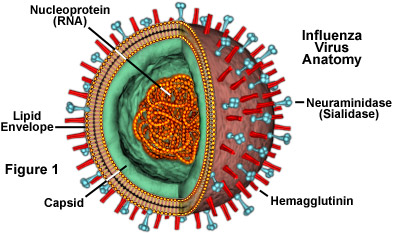
Viruses are, essentially, nucleic acid particles surrounded by a protein capsid and a lipid envelope. The nucleic acid can be either DNA or RNA, and in the case of influenza its the latter. Sticking off of the outer coating are little markers called "antigens". While there are many different types of antigens, two in particular are important: one called hemagglutinin and another called neuraminidase. For influenza viruses, there are 16 known types of hemagglutinin antigens and 9 known types of neuraminidase antigens. Since a particular virus strain will only have one of each, they are referred to by the types of these two antigens present.

For example, the current swine flu that is threatening to become a global pandemic is designated H1N1. This means that it has the type 1 hemagglutinin antigen and the type 1 neuraminidase antigen. The bird flu outbreak a few years ago in souteast Asia was type H5N1. In the past 100 years, there have been pandemic outbreaks of both H2N2 and H3N2, along with the grandaddy of all flu pandemics, the 1918 influenza outbreak which was (like this year's threat) an H1N1 virus.

The problem with the flu virus is that it frequently mutates, and any mutations typically affect the antigens on the outer surface of the virus. It's these antigens that the body's immune system recognizes and attacks. So by constantly changing these to new forms, viruses are able to easily evade the body's defense mechanisms. This is one reason why it's necessary to get a new flu shot every year (and why many people each year catch the flu even after getting vaccinated against it)...the antigens on the surface of a viral strain will change enough from year to year that the body won't recognize it.*

*In contrast, antigens on the surface of the virus that causes measles do not mutate, which is why the measles vaccination that most of us got as children should provide lifetime immunity.

Strains like this H1N1 "swine flu" that has come out of Mexico are especially scary because they are mutated forms of an animal virus. In the case of this one, it's a hybrid of pig, bird, and human viruses. What this means is that, while the combination of antigen types (H1N1) is nothing new to humanity, our species has never before been exposed to the actual antigens of this virus. There is, therefor, very little if any natural immunity to it. There is, therefor, a much greater likelihood of it becoming a global killer.

News cycles

One of my final posts for last week dealt with the recent emergence of a new swine flu strain in Mexico. Over the weekend, that little news story became one of the major headlines around the world.

On my iGoogle start page, I have several widgets. One of those shows me the top 5 stories from National Public Radio. On Sunday, 4 of the 5 stories showing there were about the swine flu. As I write this, none of them are. In fact, here's what I'm seeing right now:

Since the threat posed by this new strain of the flu definitely hasn't gone away, we can only assume that this is the product of a very quick news cycle. In order to attract readers, online news sources are forced to constantly update their feeds to provide newer and fresher stories. Sometime this means that the big or important stories can get buried pretty quickly.

When I looked at this closer, though, I noticed the fourth story. "Strong Earthquake Felt in Mexico City". As in "the same Mexico City that is reeling from the new flu outbreak". Holy crap! This is starting to look more and more like a certain online video game that I've discussed here before.

Friday, April 24, 2009

That which scares me

Reports like this from Reuters: